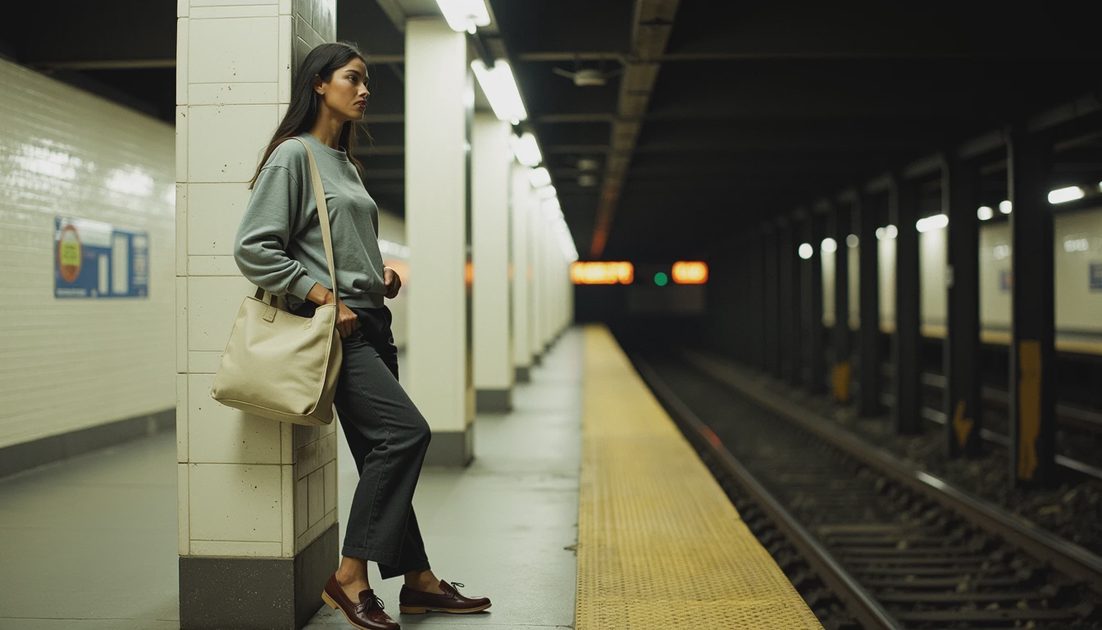
If you spend any time analyzing digital fashion content, you will notice that the word "expensive" has become the absolute holy grail of style commentary. Every second video on your feed promises to teach you "how to look expensive on a budget," or lists the "five colors that instantly make an outfit look rich." Creators stand in front of mirrors, meticulously tucking synthetic silk blouses into fast-fashion trousers, trying to mimic a very specific, polished image of upper-class leisure. The underlying assumption is always the same: the ultimate goal of getting dressed is to project an illusion of high financial status to absolute strangers on the street.
But as a fashion marketing graduate student who spends hours analyzing consumer psychology and visual data, that word makes my skin crawl.
Whenever a brand lookbook or a social media algorithm uses "expensive" as a compliment, it isn't actually talking about style, aesthetic harmony, or tailoring craftsmanship. It is playing on class anxiety. It is trying to sell a rigid, high-maintenance performance of wealth that demands flawless posture, dry-cleaned silks, and a lifestyle completely removed from real, everyday human movement. Frankly, in 2026, I am completely uninterested in teaching anyone how to perform that script. Preppy Revival 3.0 isn't about looking rich; it’s about looking grounded. It’s about building a soft uniform out of garments that possess physical weight, real history, and absolute comfort, rather than a superficial price tag. It’s not that deep. But also kind of.

Decoding the Language Trap: Luxury vs. Gravity
To understand why the "expensive" aesthetic feels so empty in real life, we have to look at what happens when you try to wear it onto a crowded G train during the morning rush hour. Traditional luxury materials—like ultra-thin silk, delicate cashmere blends, or pristine white linen—are engineered for climate-controlled environments. They wrinkle the second you sit down in a library chair, they show water spots if you get caught in a light Brooklyn drizzle, and they require a level of preciousness that completely restricts how your body moves through a day.
When you dress solely to signal wealth, your clothes become a fragile performance. You can't slouch into a coffee shop sofa, you can't sit cross-legged on the rug to edit a digital strategy presentation, and you can't carry a heavy canvas tote bag stuffed with books without worrying about tearing a delicate shoulder seam.
Preppy 3.0 replaces the concept of "looking expensive" with what I call Structural Gravity. We don't care if a garment screams luxury; we care if it has the architectural integrity to act as a psychological safety net.
The Weight of Real Cotton: A vintage, heavy-weight cotton rugby shirt or a men's poplin button-down shirt has an organic stiffness that synthetic blends can never replicate. It holds its own shape, frames your face with a crisp, open collar, and develops natural, beautiful creasing that tells a story of a real day's work.
The Shield of Heavy Wool: An oversized, deconstructed herringbone wool blazer or a chunky Irish fisherman sweater doesn't look good because it looks costly. It looks good because it has mass. It hangs from your shoulders with a deliberate drape, protects you from the autumn wind, and stands up to the chaotic realities of a daily city commute.
The Utility of Matte Leather: High-shine, unyielding patent leather shoes scream for attention and demand constant polishing. But matte, pebbled leather or textured suede penny loafers look better when they are scuffed, creased, and broken-in. The lines on the leather prove that the shoes are a functional tool for walking miles on concrete, not a static asset to be preserved in a box.

Real Life on the Rug
Last Friday afternoon, I was completely buried under a digital marketing strategy deadline. I spent four straight hours sitting cross-legged on my living room rug, surrounded by printed consumer data charts, open textbooks, and loose Polaroid shots of visual layouts.
I wasn't wearing anything that an online style manual would classify as "expensive." I had on my oldest, most washed-out navy blue athletic crewneck sweatshirt, layered over a rumpled cream-colored oxford shirt whose cuffs were haphazardly rolled up to my elbows. On the bottom, I wore relaxed-fit gray chinos and my favorite scuffed espresso-brown leather penny loafers with thick, slouched cotton socks.
As I was violently typing out the final paragraph of my project deck, Coco decided to make a dramatic leap from the top of the bookshelf, landing directly in my lap and scattering my printed slides across the floor. She spent the next twenty minutes kneading her paws into the heavy fleece of my gray sweatshirt before falling fast asleep.
When I finally shut my laptop and looked down, my shirt collar was crooked, my chinos were creased from sitting on the floor, and the left sleeve of my sweatshirt was covered in a thick layer of grey tabby fur.
If an outfit cannot survive an interactive study session, an executive nap from a tabby cat, and a three-mile walking commute through the city without looking ruined, it isn't style—it’s just a distraction. My outfit didn't look pristine, and it certainly didn't look like it belonged in a high-end luxury lookbook. But it looked entirely alive, thoroughly intelligent, and completely mine.
Stop letting algorithms convince you that your clothes need to act as a financial financial financial presentation for the world. Turn away from the fragile, airbrushed perfection of the "expensive" trend. Go find clothes that have physical weight, natural texture, and real-life durability. Let your layers slouch, let your collar fray, let the cat hair stick to your wool, and build a uniform that lets you live completely on your own terms.